Geographic barriers
Specialist care and advanced healthcare resources may be difficult to reach for communities located far from major hospitals.
We build AI-powered healthcare solutions that help doctors process clinical information, reduce workload and extend access to intelligent healthcare, especially where distance and limited resources create barriers.
Access to specialists, diagnostics and clinical expertise is not evenly distributed. For many communities, distance, cost and limited healthcare capacity create barriers to timely care.
AyurLekh is being built to bring intelligent healthcare technology closer to patients while supporting the doctors who remain at the centre of clinical care.
Our platform focuses on the practical barriers that affect healthcare delivery, from geographic access to fragmented clinical information.
Specialist care and advanced healthcare resources may be difficult to reach for communities located far from major hospitals.
Travel, repeated processes and unnecessary resource use can increase the burden on patients and healthcare systems.
Doctors may need to review large amounts of information across clinical records, reports and other sources.
Relevant findings can become difficult to notice when clinical information is scattered across workflows.
Our approach keeps healthcare professionals at the centre. AI works around the clinical workflow to help process information, reduce repetitive work and bring relevant information to attention.
AyurLekh is a connected platform across clinical work, hospital administration, company-level operations and an AI/R&D layer.
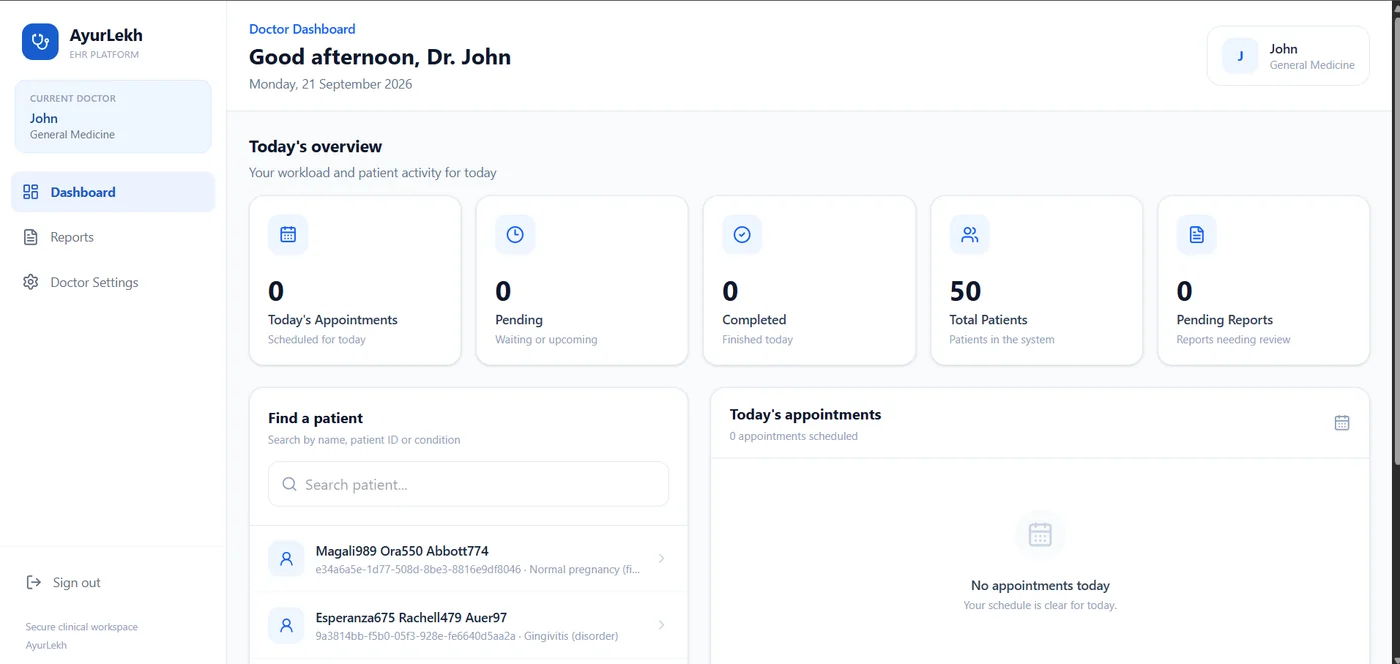
The Doctor Portal brings appointments, patients, reports and settings into a single clinical workspace.
The public website explains the ecosystem rather than copying the product's internal navigation.
Clinical workflow, patients and reports.
LIVEStaff, availability and hospital operations.
LIVEHospitals, facilities, billing, contracts and analytics.
LIVEAssistive intelligence and disease-wise research direction.
MIXED STATUSDifferent healthcare organisations have different priorities. AyurLekh lets each visitor understand the workflow most relevant to them.
A hospital administrator may need doctor management and billing visibility. A clinic may care about patient and report workflows. A diagnostic team may need imaging support. An AI/research team may care about structured clinical data and research.
The broader healthcare-AI vision is to distribute useful healthcare capabilities across district hospitals, clinics and resource-constrained settings while keeping doctors at the centre of care. Less distance. Less waiting. Less unnecessary burden. More access to appropriate care.
Each capability below maps to the actual product architecture. Every item carries a visible status.
Today's, pending and completed appointments, total patients, pending reports and patient search.
Patient search and list for clinical workflows.
Upload, scan or manually add reports with report history.
Profile, department, specialisation, qualifications, experience, licence, schedule and leave.
Total, active, available-today, on-leave and inactive doctor counts.
Directory, search/filter, detail panel and account status.
Billed this month, active hospitals/facilities, outstanding and revenue by facility.
Hospital list, location, plan, facility count, monthly billing and status.
Category, billing cycle, default price, hospitals using and status.
Hospital-wise invoices, issue/due dates, totals, paid amount and status.
Payment tracking, plan, billing cycle, monthly amount, renewal date and status.
Collected this month, hospital accounts, facility usage and revenue/adoption.
AI-assisted report workflows and local, Ollama-based assistance are separate from the live feature set.
Future direction for privacy-aware disease-wise research collaboration.
The Reports module is a real workflow: select a patient, choose a report type, upload, scan or enter manually, add clinical notes, then review report history.
Start in patient context.
LIVESelect the report category.
LIVEBring the report into the record.
LIVECapture context for review.
LIVEUse status and date filtering.
LIVE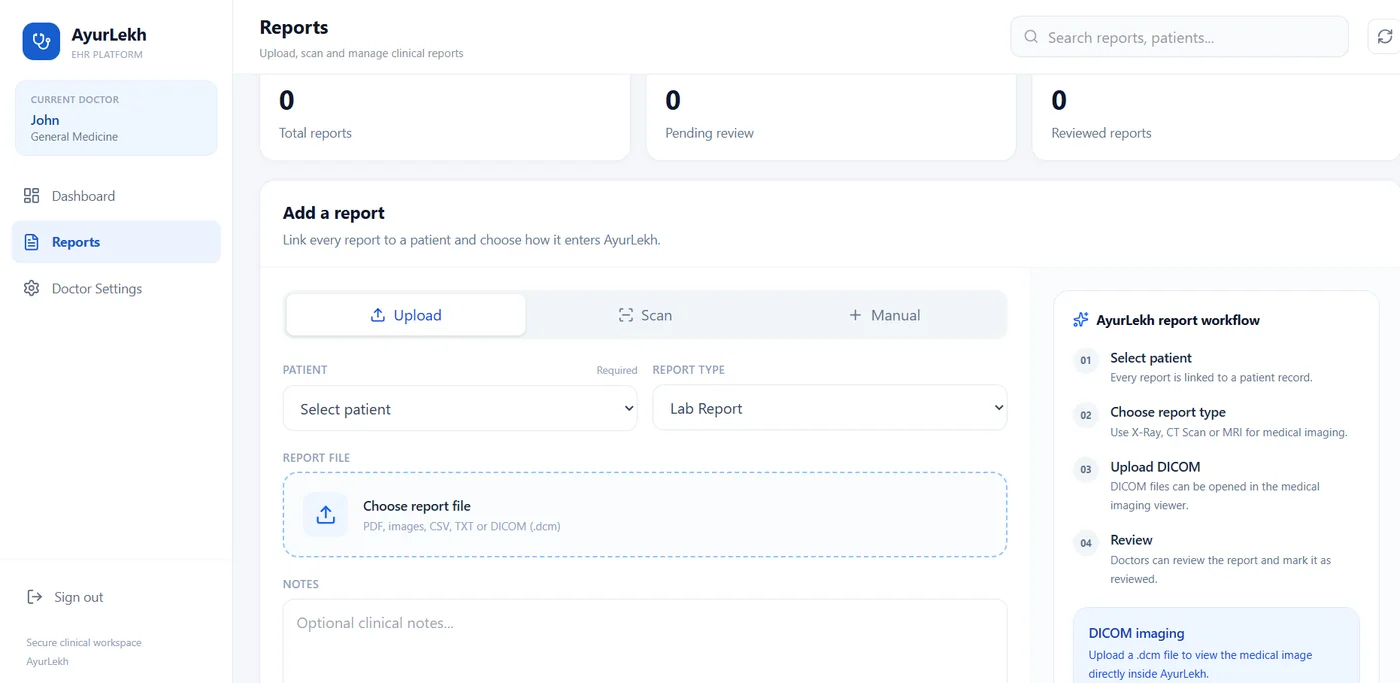
Reports, laboratory information and imaging can be difficult to review when scattered across formats and workflows. Structured report handling creates a more coherent view.
The wider AI vision includes extracting and structuring information from reports and supporting clinically appropriate imaging workflows, subject to validation and intended-use requirements.
AI-ASSIST / VALIDATION REQUIREDHospital administrators need visibility over doctors, facilities, billing, contracts and analytics, not just a clinical dashboard.
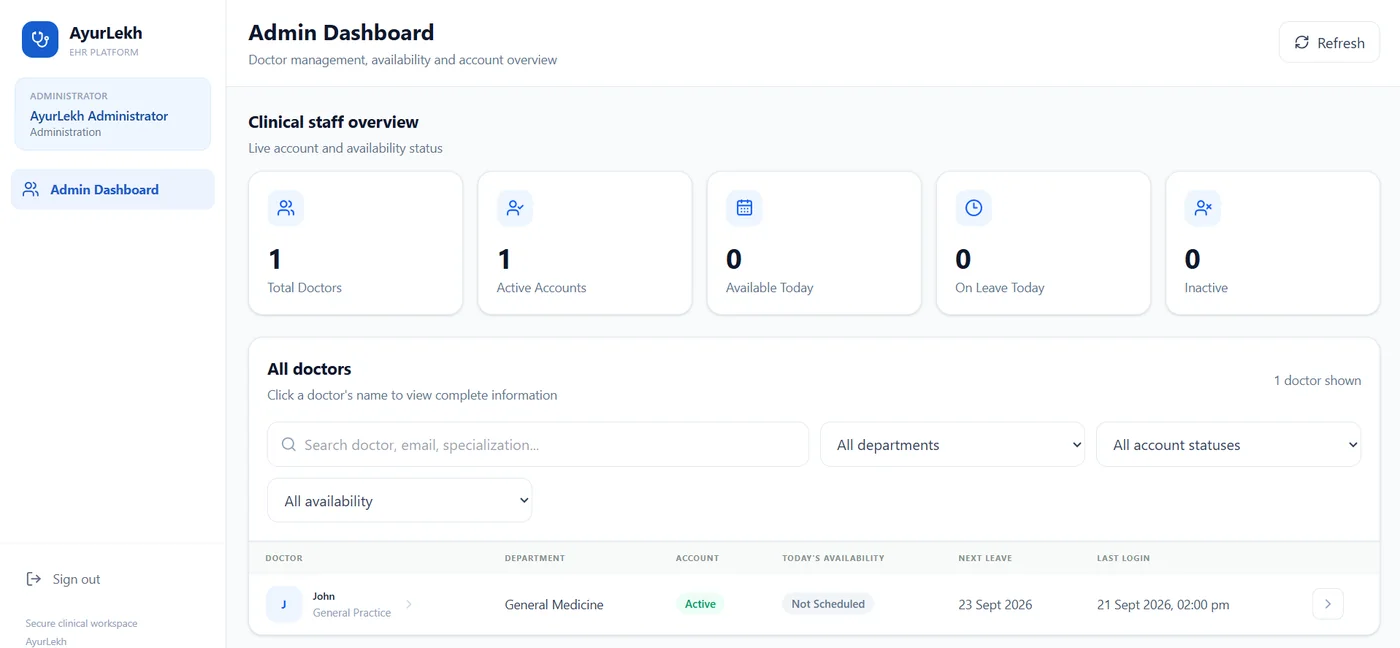
Directory, search/filter, detail panel and active/inactive status.
LIVEHospital list, facility assignment, plan and billing cycle.
LIVEInvoices, payment tracking and references.
LIVESubscription terms, renewal dates, usage and revenue analytics.
LIVEAyurLekh's admin side is part of the healthcare workflow, not an unrelated billing product.
Availability, leave and account status
Plans, facilities and status
Invoices and payment references
Usage, adoption and revenue visibility
The Amogh Company Portal is the commercial and operational layer across hospitals and facilities, not a clinical replacement for the Doctor Portal.
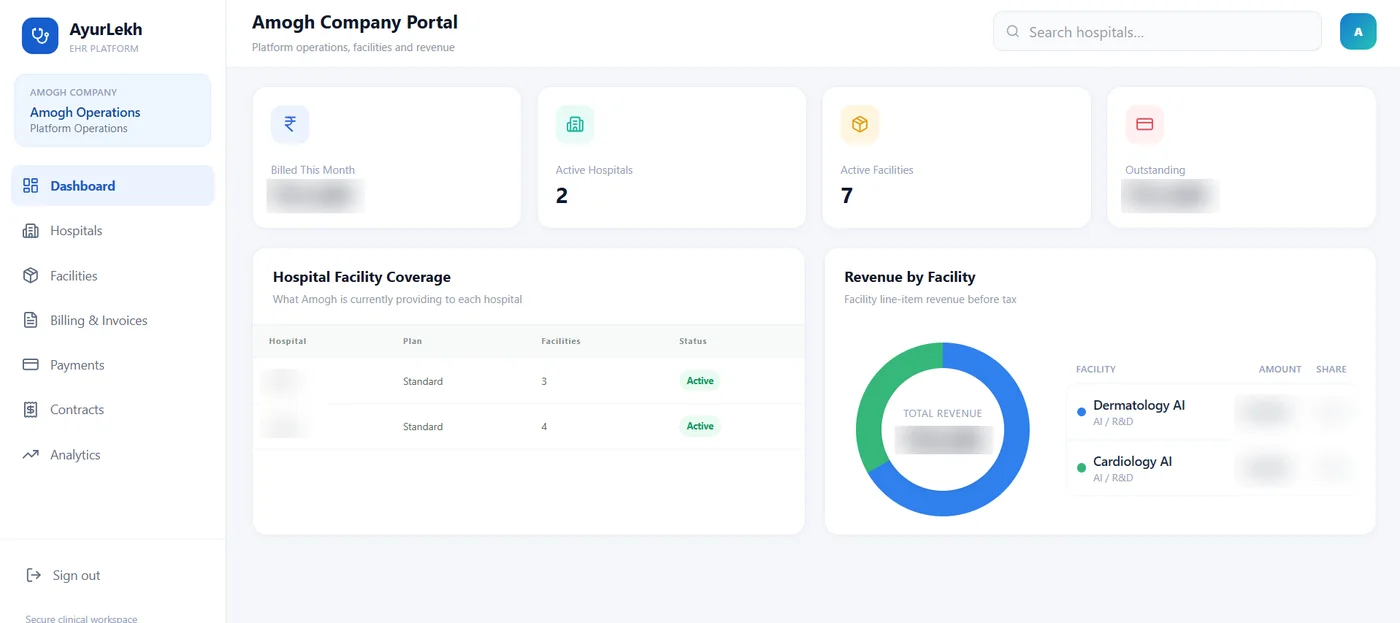
Billed this month, active hospitals/facilities, outstanding and revenue by facility.
Network list, plan, facility count, billing and status.
Registry of facilities and AI solutions used as the factual basis for AI/R&D content.
Billing, invoices, payments, contracts and analytics.
Amogh gives a multi-hospital group visibility over its network: commercial and operational, not clinical.
AyurLekh's AI story is disease-specific and status-labelled. It is designed as an intelligence layer around healthcare professionals, not autonomous diagnosis.
AI can structure symptoms and history, organise reports, support clinically appropriate imaging workflows, reduce repetitive documentation and highlight information that may deserve clinician review.
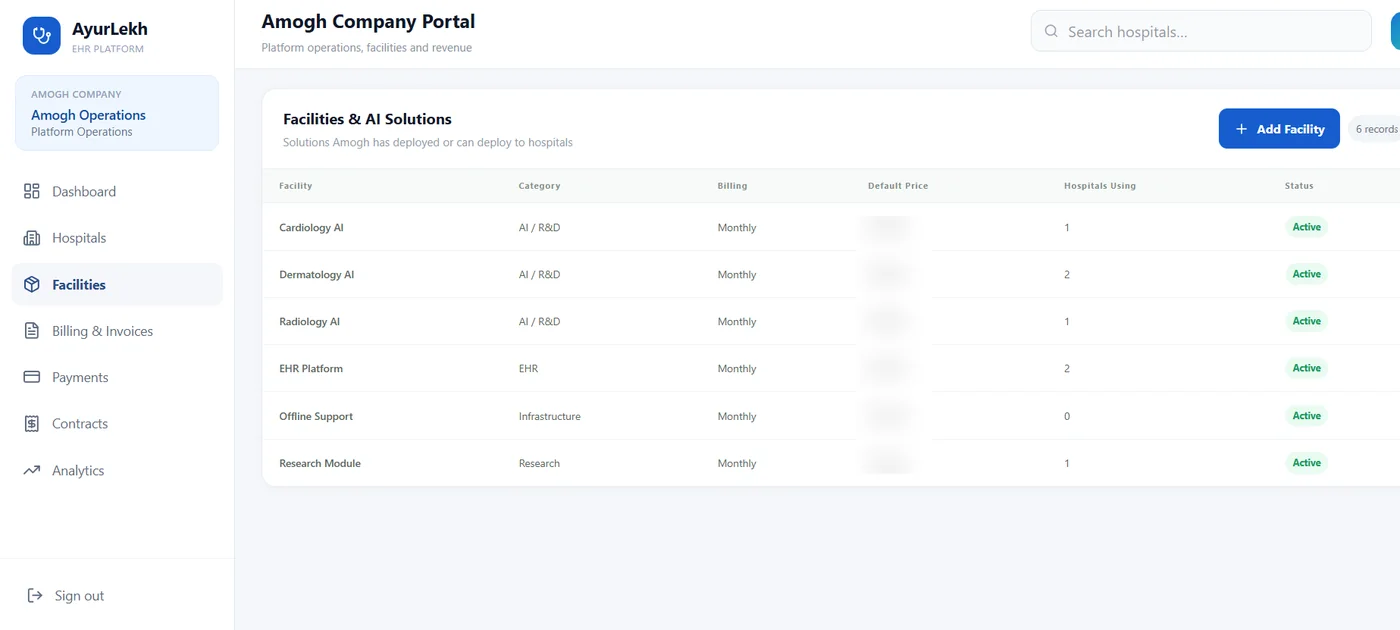
Disease-specific workflows, AI-assisted analysis, image/report workflows and patient segmentation.
Direction: support structured attention to skin-related information. An assistive development direction, not a validated autonomous diagnostic claim.
Disease-specific workflows, clinical data analysis and AI-assisted insights.
Direction: specialty intelligence around the doctor, as a modular AI platform that can support multiple specialties.
Imaging workflows, X-Ray/CT/MRI, DICOM support and AI-assisted imaging direction.
Important: imaging support requires validation. No clinical accuracy or autonomous diagnosis is claimed.
Disease-wise research, structured clinical data, privacy-aware collaboration and federated-research direction.
Long-term direction: research across healthcare settings while respecting privacy and deployment constraints.
The clinical AI is not yet a validated diagnostic product, so this page makes no clinical-accuracy or diagnostic claims.
AI outputs support rather than silently replace clinical judgement.
Clinical claims should be supported by evidence and evaluation.
Users should understand what the system can and cannot do.
Higher-risk or uncertain cases should be surfaced for professional review.
This section intentionally avoids unverified certifications or compliance badges and explains the implemented principles documented in the product proposal.
Role-based login per portal: Doctor, Admin and Amogh.
Role-based access and account activation/deactivation.
Patient records scoped to authorised clinical roles.
AI/R&D features are status-labelled and not presented as unverified diagnostic claims.
Product information, FAQs, AI insights, EHR insights, updates and demo material.
Overview of AyurLekh's platform, portals, modules and AI/R&D status.
Verified hospital stories, outcomes and implementation examples will be published here.
COMING SOONCommon questions about the platform, implementation, modules and AI status.
AI as decision support: validation, human oversight and responsible deployment.
Deep dives into reports, DICOM, doctor workflows and hospital operations.
Verified releases and screenshot refreshes as the product evolves.
COMING SOONShort product walkthroughs for Doctor, Admin and Amogh experiences.
Where someone lives shouldn't decide the care they receive. AyurLekh gives doctors and hospitals tools that remove everyday friction, so more of their time goes to patients.
Reports, history and prescriptions sit in one connected record, so a patient isn't starting from zero at every visit.
Clinical information is organised in one place and AI helps sort and summarise it. The clinical decision always stays with the doctor.
Staff, availability and facilities are visible in one view, so day-to-day coordination runs with less back-and-forth.
Our long-term goal is to bring useful healthcare technology to underserved communities, where specialists are hardest to reach.
We want to help doctors process clinical information faster, reduce their workload and bring dependable healthcare technology to places that have been left behind. Every product decision is measured against one question: does this help someone get better care?
AI assists. It never replaces clinical judgement or responsibility.
Live features, features in development and research directions are always labelled separately.
Health information is sensitive. We handle it with care and describe only what is actually implemented.
Every module starts from how clinics and hospitals actually work day to day.
Doctor dashboard, patient search, reports and settings form the clinical base.
Admin capabilities connect doctor management, availability and operational visibility.
Amogh adds hospitals, facilities, billing, payments, contracts and analytics.
Disease-specific AI, AI-assisted reporting and research directions are clearly status-labelled.
Tell us about your hospital, clinic or imaging centre and the workflows you'd like to see. We'll shape the walkthrough around your team.